7 Things I Do Every Night to Keep My Senior Dog Comfortable (and Finally Sleeping)
Paw Pulses Team · · 10 min read
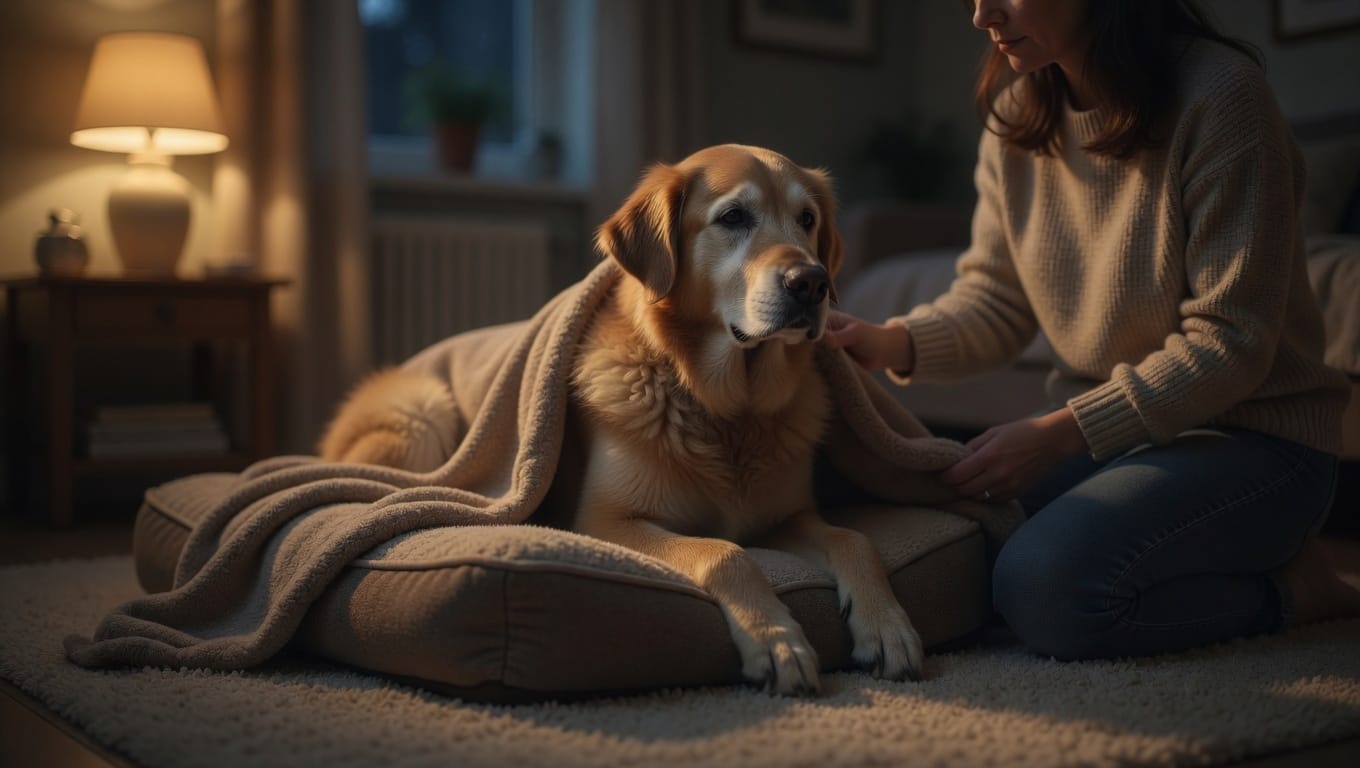
By Paw Pulses · ~9 min read · Updated April 2026
Affiliate disclosure: Some links in this article are affiliate links. If you buy through them, we earn a small commission at no extra cost to you. We only recommend products we'd give our own senior dogs. Full policy: pawpulses.com/affiliate-disclosure.
The first night Buddy stopped sleeping was a Wednesday in February. He was thirteen. He'd had a normal evening — dinner, a slow walk, a quiet half-hour on the rug while we watched TV. Then around 11 PM he stood up, walked to the back door, walked back, walked to my chair, walked back, lay down, stood up again. He did this for two hours.
I thought he needed to go out. He didn't. I thought he was hungry. He wasn't. I thought maybe he had to throw up. He didn't. He just couldn't get comfortable, and he couldn't tell me why, and so we both stayed up.
The next night, the same thing.
It took me about six weeks to figure out the routine that helped him. It wasn't one product or one trick — it was a sequence of small things, layered on top of each other, that addressed the four reasons most senior dogs lose their good nights: stiff joints in the cold of evening, mild gut discomfort that's easier to ignore in daytime, anxiety from declining senses, and a sleeping surface that wore on him in ways he couldn't articulate.
This is the routine that worked. I do it for him every night. He's fifteen now, and most nights he sleeps through. The nights he doesn't, I usually know why.
I'm not selling certainty. Every senior dog is different. But the seven things below have helped enough other dogs in our newsletter community that I think it's worth writing them down properly.
The 7 things, in order
1. Supplement at 7:00 PM (not at bedtime)
Joint supplements work better when they're given with food, not on an empty stomach right before bed. The meal protects the gut from any irritation, and food slows gastric emptying enough for fuller absorption of the active ingredients. Bedtime dosing on an empty stomach is reliably less effective for most senior dogs.
For Buddy I switched joint supplement timing to evening dinner the same week I started this routine. Stiffness on morning walks improved noticeably within ten days.
If you're not on a joint supplement yet, the foundation pick is Nutramax Cosequin DS Plus MSM — a glucosamine + chondroitin formula with manufacturer-funded clinical research and broad veterinary familiarity. We cover the full evidence base for joint supplements in our vet-aligned comparison.
If your senior also has soft stool issues at night, a probiotic with the supplement helps both — Purina FortiFlora sprinkled on dinner is the strain-specific one most vets reach for.
2. Slow walk at 8:00 PM (15 minutes, not vigorous)
The night Buddy stopped sleeping, he hadn't had any evening movement. Once we added a fifteen-minute slow walk at 8 PM, he settled noticeably better.
The reasons this matters for senior dogs:
- Joints stay warm — sustained gentle motion keeps synovial fluid flowing, which keeps stiffness from setting in over a long night.
- One last bathroom without rushing — older bladders empty more completely with movement than standing still.
- Mental wind-down — sniffing on a quiet street is meditative for dogs the way reading a book is for us. Pulls the energy down without exciting them.
- Gut motility — gentle movement helps digestion finish before bed, which means less stomach gurgling at 2 AM.
What it isn't: a fetch session, a real run, or stairs. Anything vigorous past 7 PM resets a senior dog's energy in ways that make sleep harder, not easier. Save the actual exercise for morning.
3. Bed prep at 8:30 PM — heat the surface before he gets there
This is the change that surprised me most. Senior dogs sleep 14–18 hours a day. The surface is doing more work than people realize.
Buddy used to crash on a regular dog bed. Hard floor underneath, thin foam, no warmth. By February his hips were objecting to it but I couldn't see the problem because the bed looked fine.
Replacing it with an orthopedic + heated bed — and turning the heat on 30 minutes before bedtime so the bed is warm when he climbs in — was the biggest single change in the routine.
The science is straightforward:
- Joints stiffen in the cold; warmth keeps them mobile through the night.
- A 4-inch memory-foam base gives bony hips real support that thin pads don't.
- Pre-warming means his body doesn't have to spend the first hour of sleep heating the bed up.
Two beds I'd recommend depending on budget:
- Best overall: Furhaven Orthopedic Heated Sofa Bed — joint support + warmth in one. Best for dogs with diagnosed arthritis or hip changes.
- Budget pick: K&H Pet Products Thermo-Lounger — heated pad style, no thick foam. Works well for seniors without significant joint issues who just need warmth.
Both have removable, washable covers — non-negotiable, because senior dogs leak in their sleep more than you'd guess.
4. Brushing + paw check at 8:45 PM (5 minutes)
This is partly practical and partly bonding. The practical reasons:
- Brushing redistributes skin oils, which prevents dry-skin itching that wakes a senior dog at 3 AM.
- A paw check catches cracks, embedded debris, or yeast smell before they become a problem you only notice when the limp shows up.
- Quick massage of stiff joints — circular, gentle pressure — primes them for rest.
The bonding piece matters more than I expected. Senior dogs need physical reassurance the same way they always did, and a five-minute grooming ritual at the same time each night is a clear "the day is winding down" signal.
If your senior's paws are dry or cracked, especially in winter, Musher's Secret Paw Wax applied at this stage gets ~8 hours of overnight absorption. Way more effective than morning application.
5. Final water + bathroom at 9:30 PM
The last bathroom break of the night should be after the wind-down, not before it. Two reasons:
- Senior bladders don't hold what they used to. A 9:30 PM trip means there's a real chance she sleeps until 6 AM. A 7:30 PM trip means she's likely up at 3 AM.
- Final water at 9:30 lets her drink to comfort without piling on right before bed. Do not restrict water for senior dogs without explicit vet guidance — many senior conditions (kidney disease, Cushing's, diabetes) require unrestricted access. Don't apply generic rules to a dog with a medical condition.
If your senior is on heart or kidney medication, or has any condition affecting urination or thirst, your vet's guidance overrides any nighttime routine. Ask specifically about evening fluid timing — they'll tell you if and how to adjust.
Track these patterns over time — A senior dog's "good nights" vs "bad nights" follow patterns most owners don't catch in their head. Our Senior Dog Health Tracker has a daily wellness log that flags these trends — sleep quality, water intake, evening behavior. $14, instant download. Built specifically for the kind of slow-moving changes that show up in senior dogs.
6. Lights down + calming sounds at 10:00 PM
The 10 PM mark is when the routine flips from active to passive. We turn most of the house lights off. The TV goes off. We put on quiet, low-frequency sounds — a brown-noise app or just a slow playlist.
Why this matters for senior dogs specifically:
- Declining vision and hearing can make twilight unsettling. Consistent low-light cues help orient her.
- Cognitive decline (which most senior dogs experience to some degree by age 11+) creates anxiety in transition periods. Routine reduces it.
- Sleep latency for older dogs is measurably longer than for young dogs. The wind-down period helps her actually fall asleep, not just lie down.
If your senior shows real anxiety at night — pacing, panting, vocalizing — a calming chew may help, but always run it past your vet first. Calming supplements can interact with kidney, heart, thyroid, and other senior-dog medications, and the right product + dose depends on your specific dog. VetriScience Composure Pro is one option commonly suggested by vets when calming aids are appropriate; your vet can confirm whether it's right for your dog and what the appropriate dose is.
For dogs whose nighttime anxiety is severe or sudden-onset: that's a vet conversation, not a supplement conversation. Sudden-onset cognitive symptoms in senior dogs sometimes have treatable underlying causes.
7. Lie down with him for 10 minutes
This is the one most people skip. It's the one I think matters most.
I sit on the floor next to his bed for ten minutes. I don't pet him constantly — sometimes I read on my phone. The point isn't engagement; it's presence. It's the same reason a child sleeps better when a parent is in the room for the first few minutes after lights-out.
For older dogs, the world is shrinking. Hearing fades, eyesight dims, the smells they can detect get less varied. The one thing that doesn't fade — and might even matter more — is your physical presence. Ten minutes of "I'm right here" before sleep is, in my experience, the difference between a dog who sleeps well and a dog who doesn't.
You can't measure this in a study. I'm not going to pretend it's research-backed. But every senior dog parent I know who tried it reports the same thing: better sleep, fewer 3 AM wake-ups, fewer mornings where the dog seems disoriented or unsettled.
Ten minutes. That's it. The rest of the night is hers.
What I tried that didn't work
A short honest list:
- Melatonin. Tried it with vet approval. Made him groggy in the morning, didn't visibly improve nighttime restlessness. Different dogs respond differently — yours might be a great responder. Buddy wasn't.
- CBD chews from a random brand. No effect. Quality varies wildly. We're cautiously waiting on better research before recommending specific CBD products. If you do try one, look for third-party COA testing on the product page.
- A second crate at night. Senior dogs who weren't crate-trained as adults often resist new confinement. We tried it, he hated it, we abandoned it.
- Late-evening "tiring out" play. Counterproductive. Worsened sleep latency every time we tried it.
- Soft music intended for dogs. Specifically the YouTube "dog calming" playlists. Didn't seem to help or hurt. Brown noise was more reliably calming.
- Aromatherapy / lavender diffusers. No effect we could measure. Dogs' sense of smell is so much stronger than ours that human-scented products may even be slightly aversive.
I'm not saying these don't work for any dog. I'm saying they didn't work for ours, and they're often the first things internet articles recommend without naming the trade-offs.
What changed since starting this routine
I started tracking Buddy's nights about three weeks into the routine, when I realized I couldn't remember which nights had been bad and which had been okay. Trends are invisible without data.
After three months of consistent routine plus tracking:
- Sleep through the night (no wake-ups before 5 AM): went from ~30% of nights to ~75% of nights
- Morning stiffness on first walk: noticeable on ~80% of mornings → noticeable on ~25%
- 3 AM bathroom trips: ~3 per week → ~1 per week
- Anxiety pacing in evening: most nights → maybe twice a month, usually before weather changes
I want to be honest about what this isn't:
- He didn't get younger. Senior dogs are still senior. The routine improves nights; it doesn't reverse aging.
- It's not all the products. The biggest single factor is probably the 10-minute presence. If I had to pick one thing to keep and discard the rest, it'd be that.
- It took 4–6 weeks to see compounding effects. The first week was inconclusive. The second week showed maybe 10% improvement. By week six I could see it clearly.
If you start this routine and don't see improvement in two weeks, give it longer before deciding it doesn't work. Senior dogs respond slowly to almost everything.
A note about persistent restlessness
If your senior dog's sleep is genuinely disrupted — not just imperfect, but broken in a way that wasn't broken six months ago — that's a vet conversation. Things to mention specifically:
- Sudden-onset pacing, especially at night
- Disorientation in familiar rooms after lights are out
- New panting that doesn't have an obvious cause
- Increased thirst that's noticeable
- Standing in corners or staring at walls
These are sometimes signs of cognitive decline (which has medication-based interventions that genuinely help) or other diagnosable conditions. The seven things in this article are for "she sleeps okay but she could sleep better." If you're past okay, get a vet on the phone before optimizing the routine.
The shorter version
If you don't want a step-by-step:
- Joint supplement with dinner, not at bedtime
- 15-minute slow walk at 8 PM
- Pre-warm her bed 30 minutes before sleep
- 5-minute grooming ritual with paw check
- Last water + bathroom at 9:30 PM
- Lights down at 10 PM, calming sounds on
- Sit with her for 10 minutes after she lies down
That's the routine. Buddy is fifteen. He'll be sixteen in October. He sleeps through most nights. That feels like an achievement — for both of us.
If this article was useful, our free Senior Dog Wellness Checklist has a "nighttime baseline" section for tracking sleep patterns over time.
See our full affiliate disclosure for how we choose products and earn commissions.