Senior Dog Mobility Aids: Ramps, Slings, and Supports That Actually Help (2026 Guide)
Paw Pulses Team · · 14 min read
By Paw Pulses · ~11 min read · Updated April 2026
Affiliate disclosure: Some links in this article are affiliate links. If you buy through them, we earn a small commission at no extra cost to you. We only recommend products we'd give our own senior dogs. Full policy: pawpulses.com/affiliate-disclosure.
There's a moment in most senior dogs' lives where the geometry of your home changes. The couch she's been jumping onto for ten years suddenly takes one tentative front-paw approach, then a long pause, then she looks at you. The car she leaped into at every walk needs to be lifted into. The hardwood floor she ran across becomes a polished surface she has to navigate carefully.
She hasn't stopped wanting these things. She just can't get to them the way she used to.
The good news is that the right mobility aids change this almost completely. The right ramp can give you back the dog who jumped on the couch. The right sling can give you back the morning walk. The right floor traction can give you back her confidence in her own house. None of these products fix the underlying joint changes — but they remove the friction that's making the joint changes feel worse than they have to.
The bad news is that the senior-dog mobility aisle is a mix of life-changing products and overpriced junk. We've tested a lot of both. This guide covers what actually helps, organized by the scenario you're trying to solve.
If you'd rather skip ahead, here are our top picks at a glance:
- Best couch / bed ramp: PetSafe CozyUp Folding Pet Ramp — wide, stable, telescoping, holds up to 200 lbs
- Best car ramp: PetSafe Happy Ride Folding Dog Ramp — extends to 6.3 ft, traction surface, sturdy enough for SUVs
- Best support harness with handle: GingerLead Support Harness — vet-recommended, works for stairs, walks, and bathroom assistance
- Best simple sling for short use: Walkin' Up-N-Go Lifting Sling — easy on/off, washable, padded
- Best floor traction grips: Toe Grips for Dogs by Dr. Buzby — vet-developed, real evidence base for stability
- Best stair safety upgrade: Non-slip stair treads — replaces hardwood/laminate stair edges with grippy surface
Now the practical guide.
Why senior dogs need mobility aids (and most owners wait too long)
Here's the pattern we see most often: a senior dog starts struggling with the couch around age 9 or 10. The owner notices. They feel bad about it but tell themselves "she'll figure it out." Six months later the dog has stopped trying — she sleeps on the floor instead, she avoids the bedroom, she watches the family on the couch from a distance.
The problem isn't that she gave up. It's that she made the calculation that the cost-benefit of jumping isn't worth it anymore. And once she's stopped trying, getting her back to the couch is much harder than just giving her access in the first place.
A few specific things change in senior dog mobility:
1. Joint cartilage thins. Glucosamine + chondroitin supplements help (we cover those in detail in our joint supplements comparison), but they don't restore lost cartilage. The joint still has less cushioning than it did at age 5.
2. Muscle mass declines. Senior dogs lose lean muscle even on the same exercise schedule. Less muscle = less force generation = less ability to push off for jumping or climbing.
3. Balance and proprioception decline. The mental map of where her body is in space gets fuzzier with age. This is one reason hardwood floors become genuinely scary for senior dogs — slipping triggers a fall-correction response that her aging muscles can't always execute.
4. Pain teaches avoidance. Even mild joint pain creates avoidance behavior that compounds. A dog who hesitates because of pain develops weaker muscles from less use, which creates more pain — a downward spiral.
The right intervention is to remove friction before avoidance sets in. A ramp at age 9 is a different product than a ramp at age 12. The 9-year-old might use it occasionally and reinforce her good muscle pattern. The 12-year-old needs it daily because the avoidance behavior is now baked in.
If your senior dog is starting to hesitate at any of the same surfaces she used to leap onto — that's the moment to intervene, not six months later.
Indoor mobility: ramps and stairs for couch and bed
This is where most owners start. If your senior dog has been jumping onto a couch or bed for years, those landings have been micro-injuring her joints for a long time. A ramp doesn't just help her get up — it eliminates the impact damage of getting down, which is actually worse for joints than the climb up.
What to look for in an indoor ramp
- Wide enough surface (at least 16 inches). Narrow ramps make senior dogs nervous; they need width to feel stable.
- Low incline. Aim for a slope under 18 degrees. Steeper ramps defeat the purpose — your dog still has to push hard.
- Non-slip surface. Carpeted or rubberized. Smooth ramps are dangerous.
- Folding/storable. Most ramps are surprisingly large. Folding makes them tolerable in a normal living room.
- Weight rating with a safety margin. If your dog is 60 lbs, get a ramp rated for 100+. The published ratings often assume static load, not the dynamic load of a dog's stride.
Our picks
PetSafe CozyUp Folding Pet Ramp is the standard. 16 inches wide, telescoping length up to 70 inches, 200 lb capacity, carpeted surface, folds in half for storage. Works for couches, beds, and most SUVs. The carpet is removable and washable — useful because senior dogs leave more skin oils and shed than they used to.
If your dog is small (under 25 lbs) or you have very limited space, PetSafe Solvit Pupstep Plus Pet Stairs are a steps alternative. Stairs work better than ramps for some dogs, particularly small breeds and dogs with vision issues — the discrete steps are easier to navigate than a continuous slope.
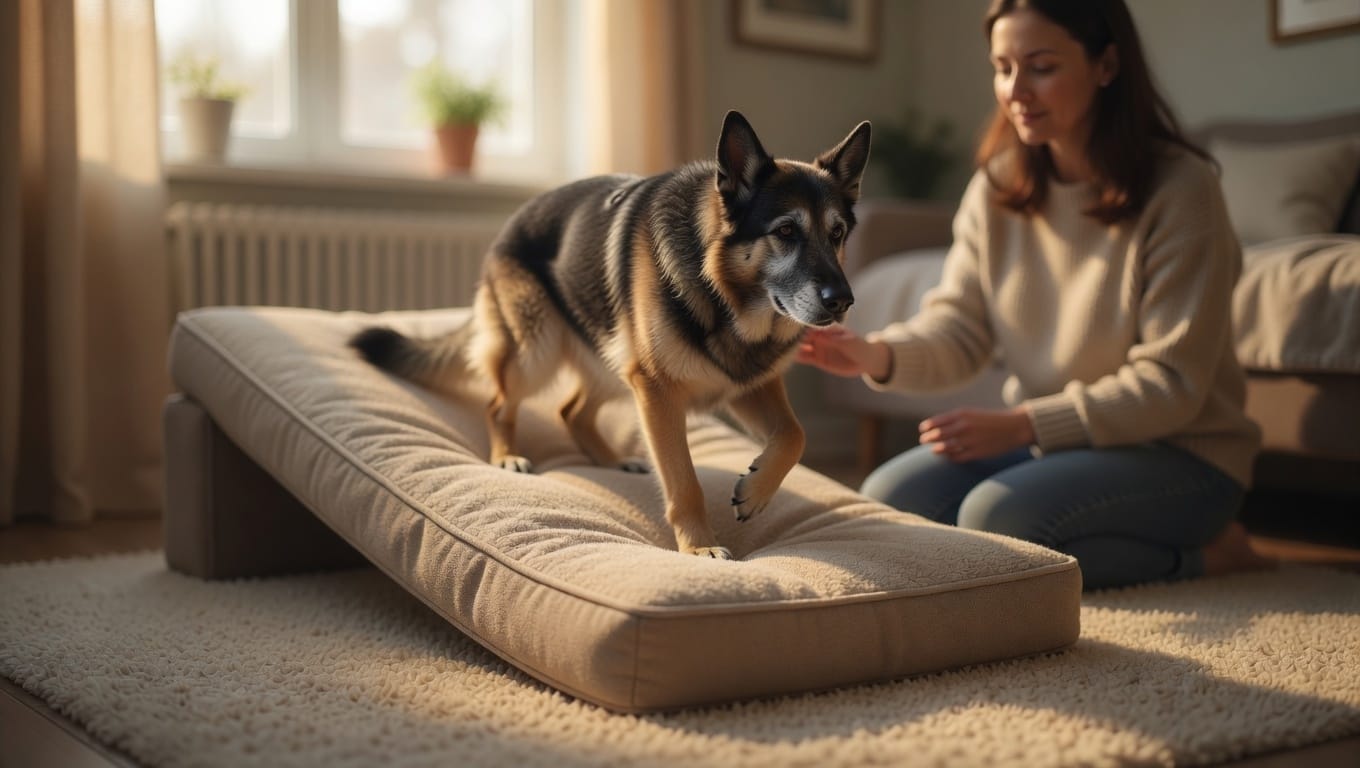
For seniors with serious mobility issues, an orthopedic foam dog ramp (basically a soft wedge instead of a structural ramp) is gentler on the joints because there's no transition between the ramp surface and the bed/couch. Good for dogs who hesitate at the top of standard ramps.
Outdoor mobility: car ramps and entry steps
The car is often the breaking point. A senior dog who can still navigate her own house may not be able to make a 24-inch leap into an SUV anymore — and lifting a 70-lb dog into a car twice a day is hard on your back, bad for the dog if you do it wrong, and not sustainable long-term.
Car ramps
The same principles apply as indoor ramps, but with two added considerations:
- Length matters more. Cars are higher than couches. You want a ramp that maintains a reasonable incline angle even at SUV height — that means 5–7 feet of length depending on your vehicle.
- Outdoor durability. It'll be wet, dirty, and weather-exposed. Metal-framed ramps with weather-resistant coatings hold up better than all-plastic.
PetSafe Happy Ride Folding Dog Ramp is the most-recommended car ramp by veterinary mobility specialists. 6.3 ft extended, 17 inches wide, 200 lb capacity, gritty traction surface that handles wet paws. Folds to about 3 feet for stowing in the cargo area.
For trucks or very tall SUVs, a 3-fold telescoping ramp extends longer to maintain a manageable incline. More expensive but worth it for a dog who's going to use it every day.
Steps for steady seniors
If your dog is still relatively mobile but just needs help with one specific step (like getting onto a deck or up onto a bed), pet stairs work better than ramps for some dogs. Some seniors find staircase-style aids more intuitive than continuous ramps.
Walking and standing support: slings, harnesses, and handles
This is the category that gets mentioned least often but matters most for dogs in mid-to-late mobility decline. A support harness with a handle gives you the ability to:
- Help her up from sitting or lying down without lifting her whole body
- Steady her on walks when her hindquarters are weak
- Assist with stairs (you take some of her weight as she climbs)
- Provide bathroom assistance for incontinent or weak seniors
What to look for in a support harness
- Padded, washable. It'll be on her body daily; comfort matters and so does cleanability.
- Handle on top, not on the side. Top handles let you provide vertical lift; side handles only provide horizontal support.
- Front + rear support options. Some dogs need help in just one area; others need both. Modular systems give you flexibility.
- Easy on/off. You'll be putting it on multiple times a day. Velcro + clip systems beat pure-buckle systems.
Our picks
GingerLead Support Harness is the vet-recommended standard. Padded, washable, comes in sizes XS through XL. The female version is cut to avoid the urinary tract; the male version has a different cut. They sell front-only, rear-only, and full-body versions — pick based on where your dog needs help.
For shorter use cases (helping her up after a nap, getting her down stairs), Walkin' Up-N-Go Lifting Sling is a simpler harness that's easy to put on quickly. Less full-time wear, more on-demand assist tool.
For dogs with hip dysplasia or hindquarter weakness specifically, Help 'Em Up Harness has a unique design that distributes weight better than most slings. More expensive, but appropriate for severe cases.
Track mobility changes month over month — Senior dog mobility decline is gradual and easy to underestimate. Our Senior Dog Health Tracker has a monthly snapshot that includes joint flexion checks, gait observations, and energy patterns — exactly the kind of slow trend that's hard to spot day-to-day. $14, instant download.
Floor traction: the cheapest, most-overlooked intervention
If your senior dog is on hardwood, tile, or laminate floors, the single highest-ROI mobility intervention is solving the slipping problem.
Why this matters: every slip on a slick floor causes a small core-muscle overcorrection. Senior dogs accumulate these overcorrections as soreness in the back, shoulders, and hips. Eliminate the slipping and you eliminate a chronic source of fatigue and pain that you may not have realized was a factor.
Three approaches, all worth doing
1. Toe grips. Dr. Buzby's Toe Grips for Dogs are small rubber rings that fit over a dog's nails to provide traction on hard floors. Vet-developed, real evidence base, surprisingly effective. Initial application is fiddly but they last 1–3 months. For dogs who slip on hardwood, this is genuinely transformative.
2. Non-slip rugs in high-traffic areas. Runner rugs in hallways, throw rugs in the kitchen, a rug at the front door. Adhesive-backed pads underneath prevent the rug itself from sliding. Non-slip rug pads keep them in place.
3. Stair treads. Carpet stair treads replace the slippery edge of hardwood stairs with a grippy surface. Self-adhesive versions install in minutes per step. Significantly safer for senior dogs descending stairs (where most slip-falls happen).
A senior dog who can move confidently in her own house has a measurably better quality of life than one who's careful with every step. This is the cheapest single category to address, and the impact shows up in days, not weeks.
Wheelchairs: when to consider one
A wheelchair (more accurately a "dog cart" or "rear-support wheelchair") is the mobility intervention most owners feel the most resistance to. There's a sense that "she's not THAT bad" or "putting her in a wheelchair feels like giving up."
The reality: a properly fitted wheelchair often gives senior dogs MORE mobility, not less. Dogs who couldn't walk a block with full hindquarter weakness can walk a mile in a wheelchair. They build muscle, regain confidence, and often live longer than dogs in similar mobility decline without the support.
When to consider one
- Your dog can no longer support her hindquarters reliably
- Walks have become brief and frustrating for her (not just "shorter than they used to be")
- A support harness is helping but you can't be at the other end 24/7
- Your vet has confirmed there's no acute treatable cause (e.g., a slipped disc that surgery could fix)
Recommended brands
Walkin' Wheels Wheelchair is the most-adjustable, most-recommended brand. Comes in sizes from mini to giant. Adjustable wheelbase means it can fit your dog as she ages and her measurements change. Real customer support if you need fitting help.
For severe cases — both rear and front limb weakness — Walkin' Wheels 4-Wheel is the four-wheel version. Less common need but available.
A wheelchair fitting is worth doing right the first time. If possible, talk to a veterinary rehabilitation specialist about sizing rather than guessing from web charts. A poorly-fitted wheelchair can cause sores; a well-fitted one is life-changing.
How to introduce a mobility aid without overwhelming her
Senior dogs don't take to new equipment instantly. Most need 3–7 days of gradual introduction before they'll use a ramp or harness on their own.
The introduction protocol
Day 1–2: Place the ramp/harness in the room where she spends time. Don't ask her to use it. Let her sniff it, walk past it, ignore it. The goal is removing the "this is new and scary" response.
Day 3–4: Treat at the bottom of the ramp. Treat at the top. Let her go up if she wants but don't push it. For harnesses, briefly put it on with treats, then take it off — building tolerance, not full use.
Day 5–7: Encourage actual use. Treat her for going up the ramp. Walk her on a short, calm walk in the harness. Build successful associations.
After day 7: Most senior dogs will be using the equipment routinely. Some take longer — that's fine. The slow introduction prevents the dog from forming an avoidance memory ("the ramp scared me once, I'll never use it") that's hard to undo.
If your dog refuses entirely after 2 weeks of patient introduction, the equipment may not be the right shape/size/style for her. Try a different version before deciding she just won't use mobility aids.
What to skip (mobility products that don't earn their price)
A few categories that get marketed hard but rarely deliver:
- "Magnetic therapy" collars and pads — no evidence of joint or muscle benefit in dogs.
- Vibrating "massage" platforms — most senior dogs are unsettled by them, not soothed.
- "Anti-arthritis" shoe-style booties — solve a problem most dogs don't have. Slipping is a floor traction issue, not a paw issue. Boots that fix slipping (rubber-soled) are actively dangerous outdoors because they reduce traction on grass.
- Elevated dog beds claiming joint support — most aren't actually orthopedic. A 4-inch memory foam bed is what helps; an elevated cot is just elevated.
- Compression sleeves for limbs — limited evidence in dogs. Used in some rehabilitation contexts but not as a daily-wear consumer product.
The mobility aid market is a mix of real medical products and lifestyle marketing. The categories that have evidence — ramps, support harnesses, traction aids, wheelchairs — are the ones to invest in. The novel categories with marketing claims are usually marketing.
A practical layered approach
If you're trying to figure out where to start, work from cheapest-and-highest-ROI to most-significant:
Tier 1 (under $50, biggest impact for most dogs):
- Toe grips for hard floors
- Non-slip rugs in high-traffic areas
- Stair treads
Tier 2 ($50–$150, when she's struggling with specific surfaces):
- Couch/bed ramp
- Support harness for assists
Tier 3 ($150–$400, for active mobility decline):
- Car ramp
- Higher-end support harness (Help 'Em Up or GingerLead full-body)
Tier 4 ($400+, for significant mobility loss):
- Wheelchair / dog cart with proper fitting
- Veterinary rehabilitation referral
Most senior dogs benefit from Tier 1 the moment they reach about age 9 — before they're even visibly struggling. Tiers 2 and 3 come in as needed. Tier 4 is for the smaller subset of dogs whose mobility decline is severe.
When to involve a vet
Most mobility aids don't require veterinary input, but a few situations warrant a conversation first:
- Sudden mobility loss — could be a slipped disc, neurological event, or other treatable acute condition. Don't just buy a wheelchair without a vet visit.
- Dragging a leg or knuckling under — neurological signs that need diagnosis before mobility-aid decisions.
- Pain visible during use of any aid — if she's whimpering or flinching, the equipment may be hurting more than it's helping.
- Wheelchair fitting — vets and especially veterinary rehabilitation specialists can fit a dog more accurately than a web chart.
For ongoing senior care, a veterinary rehabilitation specialist (not a regular vet — these are dedicated rehab vets) can be transformative for senior dogs. They do hydrotherapy, targeted exercise, and gait analysis. If you're in a major metro area, search for "canine rehabilitation specialist" and consider a single visit even if you're not in crisis. The recommendations they make can extend mobility years.
The bigger picture
Senior dog mobility decline is one of the most universal experiences of senior dog ownership and also one of the most under-addressed. We invest in beds, food, and supplements without thinking enough about the geometry of the home she's living in.
Most senior dogs would benefit from at least three of the products in this article. Most owners buy one, see partial improvement, and move on without trying the others. The dogs that do best are the ones whose owners do the layered approach — toe grips PLUS a ramp PLUS a support harness PLUS a properly orthopedic bed.
Each individual product helps. Together they remove enough friction that an aging dog can keep enjoying her house, her family, and her routine for years longer than she could without them.
That's a worthwhile gift to give her. She'd give it to you.
Related guides
The next layer after access is rest, then the daily arthritis routine:
- 🛏️ How to set up a senior dog's sleeping area — orthopedic beds, height, and the sleep setup that takes pressure off sore joints. Short list of bed picks: shop orthopedic beds.
- 🦴 12 ways to help a senior dog with arthritis at home — the vet-aligned daily comfort routine
- 📋 Free Senior Dog Wellness Checklist — print the daily mobility check
- 💊 Best joint supplements for senior dogs (2026) — one comparison if you're also looking at supplements
A printable next step
If you want a fridge-door version of the daily mobility check, grab the free Senior Dog Wellness Checklist. One email, 5-page PDF, no spam.
See our full affiliate disclosure for how we choose products and earn commissions.